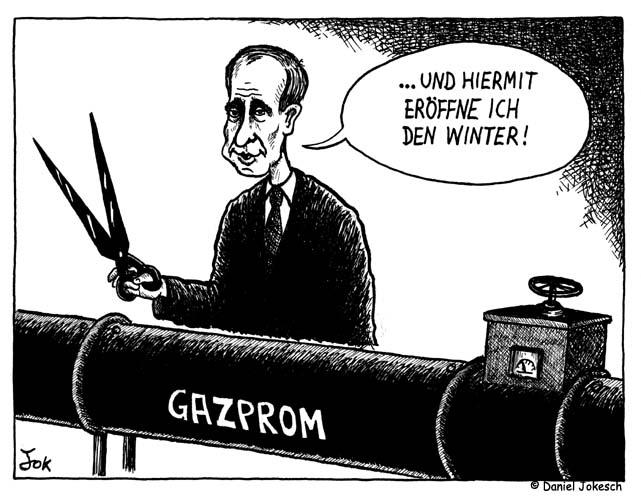
Russia, Ukraine Sign Deal to Resume Natural-Gas Flows to EU
Russia and Ukraine signed a deal
to
resolve a dispute over natural-gas prices and transit fees,
paving the way for the
resumption of shipments to the European
Union for the first time in almost two weeks.
Ukrainian Prime Minister Yulia Timoshenko returned to
Moscow today after hammering out the broad
outlines of a deal
during weekend talks with her Russian counterpart, Vladimir
Putin. The
contracts were signed by OAO Gazprom, Russia’s gas
exporter, and NAK Naftogaz Ukrainy, the state
energy supplier.
“Clearly there was a breakthrough over the weekend,”
Roland Nash,
chief strategist at Renaissance Capital in Moscow,
said today in a Bloomberg Television interview.
“It’s a little
enthusiastic to say we’ve left the trouble behind.”
Gas prices in
the U.K., Europe’s biggest market, slid the
most in two years on expectations that supply
shortages in many
parts of central Europe and the Balkans will shortly be eased.
Ukraine will
pay higher European prices for Russian gas from
2010, after a 20 percent discount this year. In
return, 2009
transit fees for Russia will remain at last year’s level.
Putin said
transit flows to Europe will resume in full
after both sides signed 10-year contracts for both
natural gas
and transit.
Gazprom and Naftogaz will use direct contracts in future.
In
the past, they’ve employed RosUkrEnergo AG, the Swiss-based
trader half-owned by Gazprom, as an
intermediary.
European Commission President Jose Barroso earlier
expressed frustration at
the delay by both sides in getting gas
flowing again to the 27-nation bloc.
“So far they
have been unable to do it and of course this
raises serious concerns about their credibility as
our
partners,” he told reporters in Brussels.
Three Days
OMV AG, Austria’s largest oil and gas company, expects
Russian gas to begin arriving
at its Baumgarten hub two to three
days after Gazprom turns on the taps.
Russian gas flows
via Ukraine were halted Jan. 7 after
Gazprom accused Ukraine of siphoning off transit flows for
its
own needs, a charge the country denies. The crisis has left
parts of eastern Europe without
fuel during freezing
temperatures. Europe relies on Russia for a quarter of its gas,
80 percent
of which is carried through Ukraine.
“This crisis is off the scale of anything that has
ever
happened before,” Jonathan Stern, director of gas research at
the Oxford Institute for
Energy Studies, said yesterday.
U.K. gas for delivery this summer slumped as much as 8.1
percent today to 42.65 pence a therm, according to data compiled
by Bloomberg. Week-ahead prices
advanced 10 percent in the past
two weeks.
Mandate
The Ukrainian delegation, led by Naftogaz Chief Executive
Officer Oleh Dubina, had a mandate
to sign the gas accord,
Bohdan Sokolovskyi, President Viktor Yushchenko’s energy aide,
said
earlier in the day.
Ukraine’s Parliamentary Speaker Volodymyr Lytvyn said
earlier today
that Russia would probably charge Naftogaz between
$240 and $250 per thousand cubic meters of gas
for 2009.
The agreement “is a major step forward,” Bernhard Jeggle,
an analyst at
Landesbank Baden-Wuerttemberg in Stuttgart, said
yesterday. The 20 percent discount for Ukraine
“makes it easier
to transfer to world market price levels.”
Czech Industry Minister
Martin Riman, whose nation holds
the rotating presidency of the EU, said he remained
“realistic” in light of previous attempts to break the
deadlock between the two sides.
“The only thing that counts for the EU is the resumption
of gas supplies,” Riman said in a
statement yesterday. “For
the time being, it is not clear when this resumption takes
place.”
EU Warning
The weekend deal followed a
warning from the EU that it
might urge European companies to seek legal redress if fuel
supplies remain halted. A previous attempt by the EU to break
the deadlock failed a week ago.
The EU had labeled the talks a “test case” for the
reliability of Russia and Ukraine as
energy providers. The
supply cutoff has already prompted renewed calls for the region
to
diversify energy supply away from Russia.
European alternatives to supplies from Gazprom are
limited
and no final decision has been made on financing the planned
Nabucco pipeline, a rival
route intended to carry central Asian
gas to Europe by 2013.
Turkish Energy Minister Hilmi
Guler today called for a
speedy agreement on the link, which would run from Turkey
through
Bulgaria, Romania and Hungary to Austria.
Price Demands
Earlier this month, Gazprom cited a possible price of $450
per 1,000 cubic meters for deliveries
to Ukraine in January,
reflecting the average price in countries bordering Russia’s
neighbor.
It made the offer after saying Ukraine had rejected a
gas price of $250. Ukraine had said $201 would
be fair.
Gazprom’s prices to European customers under long-term
contracts typically lag
prices for crude and oil products by
about six to nine months. Crude has fallen by 75 percent
since
reaching a record in July. Ukraine paid Russia $179.50 per 1,000
cubic meters for gas
last year.
Gazprom’s gas output will likely fall 2 percent this year
because of lower
fuel prices, weaker demand and a milder winter,
according to a report today by JPMorgan Chase &
Co.
A 20 percent discount to European prices will still weigh
heavily on the Ukrainian
economy, said Stern.
“This strikes me as a very high price for Ukraine,” he
said in a
phone interview. “The Ukrainian economy is in rather
worse shape than Europe.”
IMF Bailout
Ukraine’s economy grew by 2.1 percent last year, the
slowest annual pace since 1999. The country, shaken by the
global financial crisis, has already
been forced to seek a $16.4
billion International Monetary Fund bailout.
E.ON AG,
Germany’s largest utility, said earlier today that
the gas deal didn’t involve European
companies.
“Evidently Russia and Ukraine reached an agreement,”
company spokesman
Adrian Schaffranietz said in a phone
interview. “European gas companies won’t be needed to
act.”
Putin had suggested that EU utilities, including GDF Suez
SA, E.ON Ruhrgas AG and
Eni SpA, pay for “technical gas”
needed to operate Ukraine’s gas pipeline system, one of the
main
sticking points in the dispute.
Russian President Dmitry Medvedev had put forward
an
alternative proposal, whereby a European bank would provide a
“letter of credit” for as
much as $1 billion for Ukraine,
guaranteeing the country’s gas payments.
Relations
between Ukraine and Russia have become strained
over efforts by the former Soviet republic to join
the EU and
the NATO.
In 2006, Russia turned off all gas exports to Ukraine for
three
days, causing volumes to fall in the EU, and also cut
shipments by 50 percent last March during a
debt spat.


 Gaskrise


 EVN : 28.1 +0.90%


 Lauda(20)

 Hagen(760)